
3 (2x 5 3 + 3) 2 = 56 x 14 3 + 144 x3 − 8x 8 3 − 72 x − 50 x 2 3 12 x 10 3 + 36 x 5 3 + 27 Critical thinking question: 12) A classmate claims that (f g) ' = f ' g' for any functions f and g. Show an example that proves your classmate wrong. Ex: f = 4, g = 2x, − 2 x2 ≠ 0-2-Create your own worksheets like this one with. Page 3 Stewart Calculus ET 6e; 3. Differentiation Rules; 3.2 The Product and Quotient Rules.
Answer
Work Step by Step
The Product Rule
Now that we have examined the basic rules, we can begin looking at some of the more advanced rules. The first one examines the derivative of the product of two functions. Although it might be tempting to assume that the derivative of the product is the product of the derivatives, similar to the sum and difference rules, the product rule does not follow this pattern. To see why we cannot use this pattern, consider the function (f(x)=x^2), whose derivative is (f′(x)=2x) and not (dfrac{d}{dx}(x)⋅dfrac{d}{dx}(x)=1⋅1=1.)
Product Rule
Let (f(x)) and (g(x)) be differentiable functions. Then
[dfrac{d}{dx}(f(x)g(x))=dfrac{d}{dx}(f(x))⋅g(x)+dfrac{d}{dx}(g(x))⋅f(x).]

That is,
[if j(x)=f(x)g(x),thenj′(x)=f′(x)g(x)+g′(x)f(x).]
This means that the derivative of a product of two functions is the derivative of the first function times the second function plus the derivative of the second function times the first function.
Proof
We begin by assuming that (f(x)) and (g(x)) are differentiable functions. At a key point in this proof we need to use the fact that, since (g(x)) is differentiable, it is also continuous. In particular, we use the fact that since (g(x)) is continuous, (lim_{h→0}g(x+h)=g(x).)
By applying the limit definition of the derivative to ((x)=f(x)g(x),) we obtain
[j′(x)=lim_{h→0}dfrac{f(x+h)g(x+h)−f(x)g(x)}{h}.]
By adding and subtracting (f(x)g(x+h)) in the numerator, we have
[j′(x)=lim_{h→0}dfrac{f(x+h)g(x+h)−f(x)g(x+h)+f(x)g(x+h)−f(x)g(x)}{h}.]

After breaking apart this quotient and applying the sum law for limits, the derivative becomes
[j′(x)=lim_{h→0}dfrac{(f(x+h)g(x+h)−f(x)g(x+h)}{h})+lim_{h→0}dfrac{(f(x)g(x+h)−f(x)g(x)}{h}.]
Rearranging, we obtain
[j′(x)=lim_{h→0}dfrac{(f(x+h)−f(x)}{h}⋅g(x+h))+lim_{h→0}(dfrac{g(x+h)−g(x)}{h}⋅f(x)).]
By using the continuity of (g(x)), the definition of the derivatives of (f(x)) and (g(x)), and applying the limit laws, we arrive at the product rule,
[j′(x)=f′(x)g(x)+g′(x)f(x).]
□
Example (PageIndex{7}): Applying the Product Rule to Constant Functions
For (j(x)=f(x)g(x)), use the product rule to find (j′(2)) if (f(2)=3,f′(2)=−4,g(2)=1), and (g′(2)=6).
Solution
Since (j(x)=f(x)g(x),j′(x)=f′(x)g(x)+g′(x)f(x),) and hence
[j′(2)=f′(2)g(2)+g′(2)f(2)=(−4)(1)+(6)(3)=14.]
Example (PageIndex{8}): Applying the Product Rule to Binomials
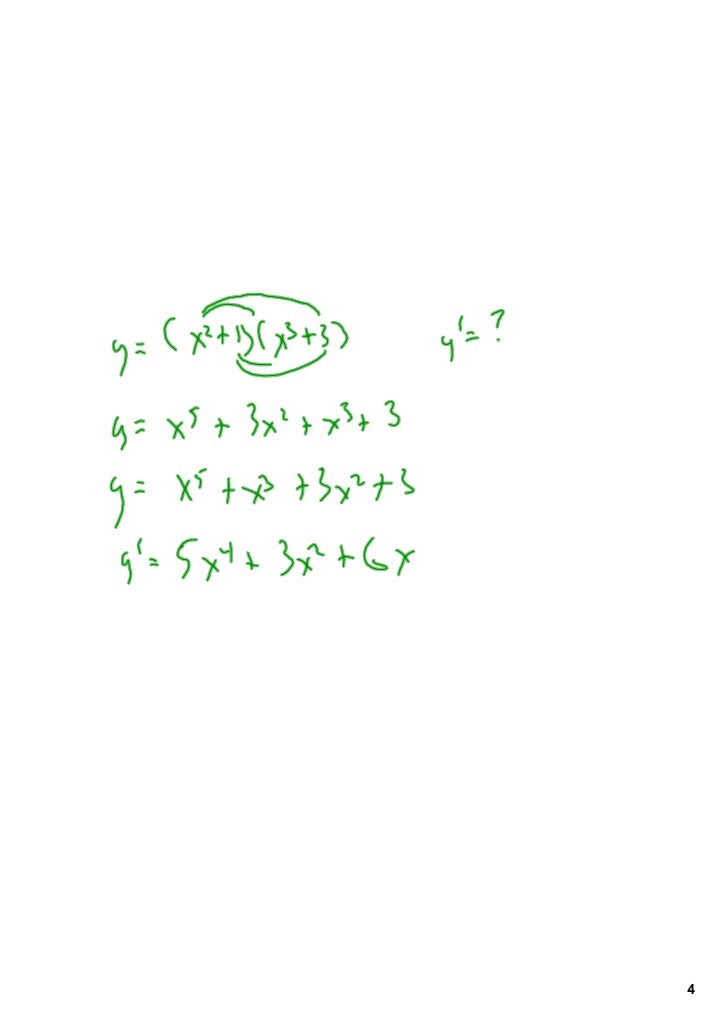
For (j(x)=(x^2+2)(3x^3−5x),) find (j′(x)) by applying the product rule. Check the result by first finding the product and then differentiating.
Solution
If we set (f(x)=x^2+2) and (g(x)=3x^3−5x), then (f′(x)=2x) and (g′(x)=9x^2−5). Thus,
(j′(x)=f′(x)g(x)+g′(x)f(x)=(2x)(3x^3−5x)+(9x^2−5)(x^2+2).)
Simplifying, we have
[j′(x)=15x^4+3x^2−10.]
To check, we see that (j(x)=3x^5+x^3−10x) and, consequently, (j′(x)=15x^4+3x^2−10.)
Exercise (PageIndex{6})
Use the product rule to obtain the derivative of [j(x)=2x^5(4x^2+x).]
Set (f(x)=2x^5) and (g(x)=4x^2+x) and use the preceding example as a guide.
3.2 Quotient Ruleap Calculus Calculator
3.2 Quotient Ruleap Calculus Equation
[j′(x)=10x^4(4x^2+x)+(8x+1)(2x^5)=56x^6+12x^5.]